WHAT IS RUPDB?
RUPDB is a software package for real-time SCADA and distributed dynamic data gathering applications. It is made up of a suite of software modules that run on a number of different operating systems: QNX, MS Windows and GNU/LINUX.
RUPDB is scalable: it is used to build simple embedded data loggers with only a few I/O points and it is also used to implement distributed networked systems that contain hundreds of data points.
RUPEMS
RUPEMS is a software package designed for the Excursion Monitoring System and similar applications. The RUPEMS package builds on top of RUPDB and adds functions required for marine environments.
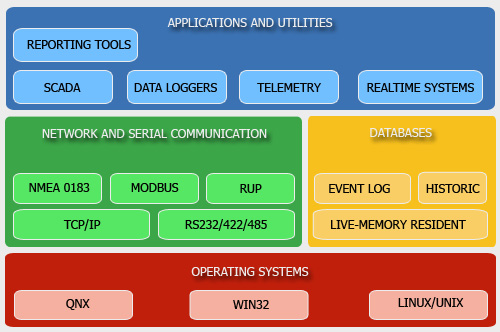
FEATURES AND BENEFITS
- Embedded Database
- High Speed
- Small Resource Footprint
- Modular
- Scaleable
- Distributed Network
- Redundant Data Links
- Multi-platform: QNX, MS Windows, GNU/Linux
- Robust/Reliable
- Customisable
- Low System Management
- Vendor-neutral Hardware
- Virtualisation Support
- Cost Effective
- Web Interface
RUPDB APPLICATIONS
- Pipeline Telemetry
- Digital Oil Field
- Data Distribution
- Data Loggers
- Intelligent Instruments
- Embedded Controllers
- SCADA Devices
- Control Systems
- Flow Computers
- Virtual Meters
RUPEMS APPLICATIONS
- FPSO Excursion Monitoring
- Shuttle Tanker Offloading
- Weather Systems
HOW IT WORKS
A typical RUPDB system will run continuously for months on end and will require little or no system management. The RUPDB software is robust – if the system starts and runs OK for the first few minutes, then it will continue to do so for a long time (usually until the power fails).
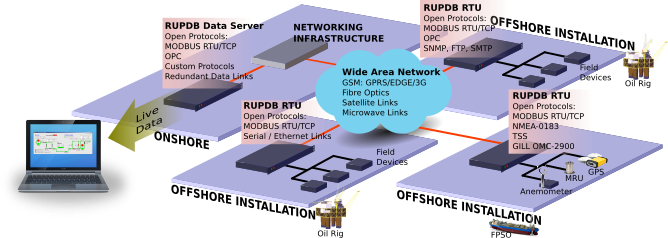
RUPDB and Networks
RUPDB is designed to support distributed network environments. The system is based on a "client/server message passing" communications model. All interactions between RUPDB processes are conducted using message passing interprocess communications (IPC) model. Networked applications hence run transparently as local applications.
RUPDB Reliability
RUPDB keeps dynamic memory allocation and freeing to a minimum (in some modules, this is eliminated completely). Process creation is also kept to a minimum: most processes such as server processes, report generators and communications drivers all run continuously. These design principles add to the reliability of a RUPDB system.
Similarly, the core RUPDB disk files such as historic database files, alarm & event logs and process state files are pre-grown to their full size when a RUPDB system is installed. These ensure that a RUPDB system will not run out of resources.
USE CASES
VIRTUALISATION
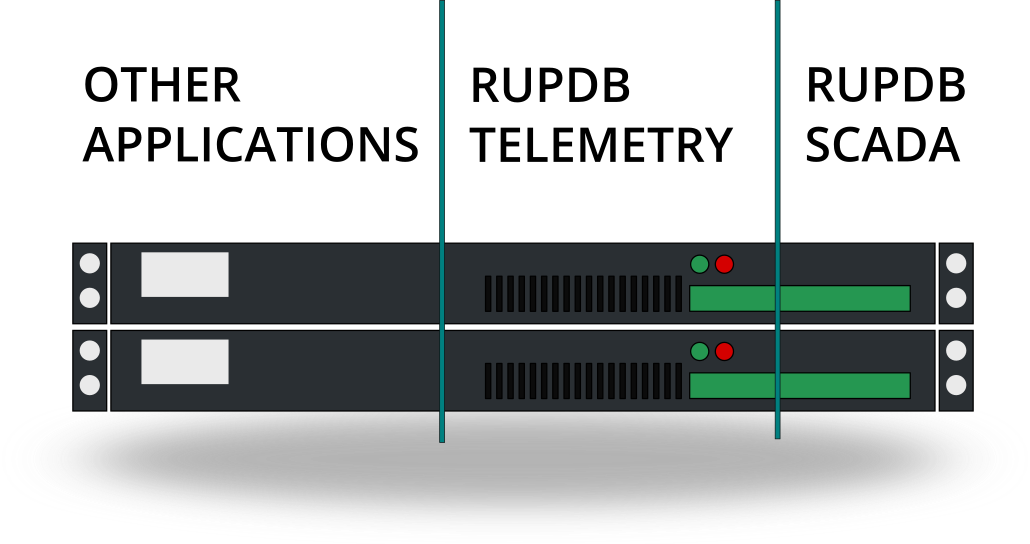
Traditionally, virtualization–allowing multiple distinct operating systems and applications to run in virtual machines and sharing the same server hardware, has been seen as a server technology. With RUPDB SCADA package, virtualization can also be applied to Telemetry and SCADA systems using standard virtualization systems such as VMware ESXi.
RUPDB allows organisations to create virtual machines to perform SCADA and Telemetry functions, optimising existing hardware and keeping operational expenses low.
BALLAST CONTROL SYSTEM
The RUPDB Computer-Based Ballast Panel Control System can replace the traditional Control Panel found in offshore floating vessels.
The RUPDB solution offers many benefits which include replacing obsolete hardware to provide a more future-proof and supportable system. RUP has supplied a Ballast Panel Control System to Maersk FPSOs.
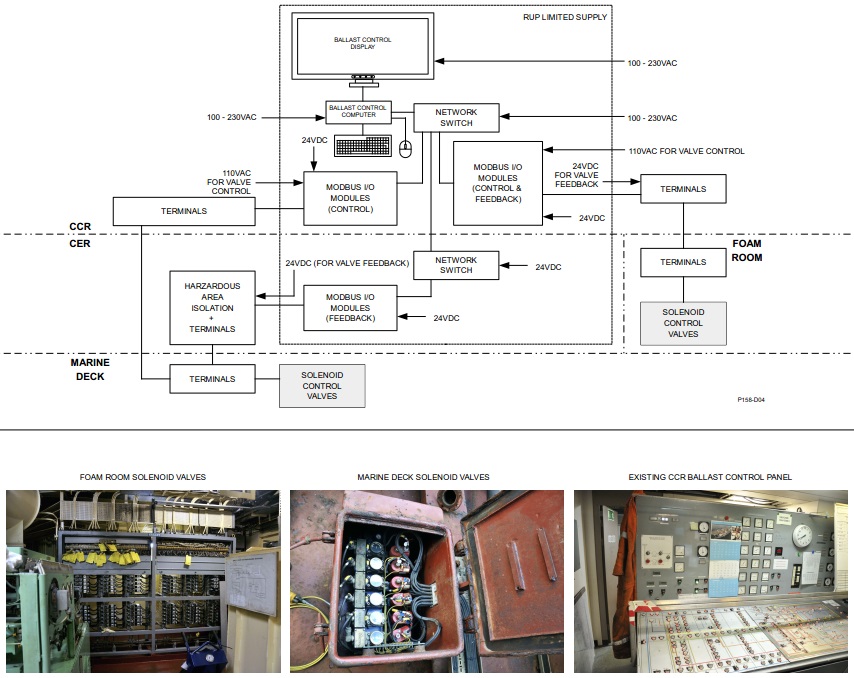 Source: RUP Project
SUPERVISORY CONTROL SYSTEM
Ninian Shutdown Signal System
The Ninian Shutdown Signal System is designed to relay discrete I/O data between the Ninian Central, Ninian
North, and Ninian South platforms for the purpose of control/shutdown and monitoring. The system has
three RUPDB Emergency Shutdown (ESD) Communications Computers, one for each platform.
The Ninian Shutdown Signal System relays discrete I/O data in the Ninian field over the CNR network using IP protocol and optimised UDP transport protocol (RUPDB modules). The ESD Communications Computers run the RUPDB SCADA software package on top of the QNX Operating System.
RUP supplied Ninian Shutdown Signal System to CNR to replace the existing Cyfas Remote Protection Supervisor System. The Ninian Shutdown Signal System has been in use since 2009.
 NINIAN CENTRAL (Source: stv.tv)
HOW TO ORDER
We supply the RUPDB and RUPEMS systems directly to our customers. Please contact us with your requirements.
CONTACT
Address: Unit 16, Netherton Business Centre, Kemnay, Aberdeenshire, AB51 5LX, United Kingdom.
Website: www.rup.co.uk
Email: rup@rup.co.uk
Tel: +44 1467 642950
Software Development, Computer Systems, Consultancy Services
Copyright © 2016 RUP Limited. All rights reserved.