PIPELINE TELEMETRY SYSTEM, PTS
The purpose of a telemetry system is to collect data at a place that is remote or inconvenient (say an oil production offshore installation) and relay to a point where the data may be evaluated (say a business onshore office). Using the RUP Pipeline Telemetry System, PTS, a pipeline operator gets various measurement information about the pipeline system remotely.
Our telemetry systems can be used to monitor and control equipment in other industries such as transportation, telecommunications, water and waste control and power.
PIPELINE INTEGRITY SYSTEM, PLIS
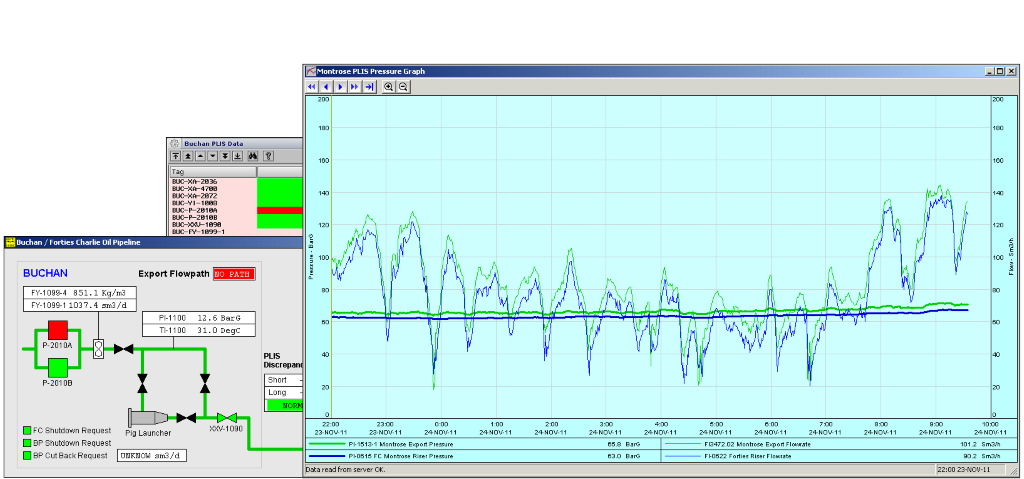
Pipeline Integrity Monitoring, PLIS, is a feature built on top of the Pipeline Telemetry System. The PLIS monitors the pipeline conditions and carries out calculations to check for leakages in the pipeline system. This is achieve by the PLIS Algorithm developed and implemented by RUP Limited.
FEATURES AND BENEFITS
- Off-the-shelf I/O & Computer Hardware
- Vendor-neutral Hardware
- RUPDB Software Package
- Live Memory-resident Database
- Disk-based Historic Database
- Open Protocols: MODBUS ASCII/RTU/TCP, SNMP, FTP
- Custom Protocols
- Email Alerting
- Graphical User Interface (GUI)
- Data Encryption
- Web Interface
APPLICATIONS
- Pipeline Telemetry
- Pipeline Integrity Monitoring
- Data Server
HOW IT WORKS
PIPELINE TELEMETRY SYSTEM, PTS
The Pipeline Telemetry System is powered by RUPDB SCADA software package which runs on various operating systems: QNX, GNU/LINUX and MS-Windows.
The PTS acquires field data via 3rd-party hardware using standard or custom protocols. The disk-based historic database holds up to 5 years of historic data in a cyclic fashion - the oldest data is deleted first when the data space is full. The system can cache up to two months of historic data making data access fast. A sequence of events log is also kept by the system. The system supports both serial and network communications.
PIPELINE INTEGRITY SYSTEM, PLIS
The PLIS computer monitors the pipeline integrity using volume-balance method. In simple terms, the standard volume flow into the pipeline is compared with the standard volume flow leaving the pipeline and a significant flow discrepancy indicates a leak. Both flow totals are available as RUPDB live-database tags and are also logged in the historic database.
Two instances of the PLIS Volume Balance Algorithm are run simultaneously: one computes the Short-term Flow Discrepancy and the other computes the Long-term Flow Discrepancy. The Short-term Flow Discrepancy is calculated as the difference between the input and output flows compared over a rolling 1 hour period. It is computed every minute and output in three forms: discrepancy flow rate, discrepancy quantity and discrepancy flow. The Long-term Flow Discrepancy is calculated over a 24 hour period.
Start-up and Shutdown
The system is tolerant of power failure. If a controlled shutdown and power off is required, a System Shutdown button is available on the graphical user interface. After power is re-applied, the system will automatically boot into the application software: no user intervention is required.
User Interface
The Pipeline Telemetry System runs headless in most applications but a user interface is provided for diagnostics and viewing data. The system displays information in a windows-based graphical user interface. Most of the normal user interface functions such as display navigation can be performed using a mouse only.
SPECIFICATIONS
All specifications provided are current at the time of publication. However, due to our continual product improvement policy, we reserve the right to make changes at any-time without notice. We also supply hardware to meet client's requirements.
HARDWARE
We supply the PTS / PLIS using various hardware options and virtualisation options to meet clients' requirements.
| Standard PTS / PLIS Computer |
|---|
| Shallow Depth 1U Rackmount Industrial Computer |
SOFTWARE
| Data Formats | |
|---|---|
| Modbus Protocols | Modbus ASCII/RTU/TCP, Modbus RTU over TCP |
| OPC | OPC support via Modbus servers |
| RUPDB Protocols |
RUPDB Plant Data and Transport Protocols The RUPDB Plant Data Protocol is designed to be an application level protocol used to implement telemetry data links. The protocol relies on a lower level transport protocol which can reliably deliver data packets between two end points. The RUPDB Plant Transport Protocol is designed to provide a transport for a higher level protocol used to implement a telemetry data link. The protocol will typically be used to implement one or more point to point links which will be in continuous use. The protocol supports two types of framing: stream framing for (RS232/RS422/RS485 and TCP) and packet framing (for UDP transmission systems). |
| Others | FTP, SMTP, SNMP, Serial ASCII |
USE CASES
THE UK FRIGG PIPELINE TELEMETRY SYSTEMS
The Frigg UK System is a natural gas transportation system from the North Sea gas fields to St. Fergus* near Peterhead in Scotland. It transports natural gas from the Alwyn North, Dunbar, Ellon, Grant, Nuggets, Frigg, Bruce, Ross*, Captain, Buzzard, Tartan*, Piper*, Chanter, Galley* **, Hamish, Highlander, Ivanhoe* **, MacCulloch*, Petronella, Saltire, and Rob Roy* ** fields.
* RUP's Products and Services are deployed here.
**These fields are now decommissioned.
RUP has deployed Pipeline Telemetry Systems and Systems Integration solutions in the Frigg UK System for the following clients:
- ConocoPhillpis
- GL Noble Denton
- Maersk FPSOs
- Talisman Energy (now Respsol Sinopec)
- Total UK
- Wood Group
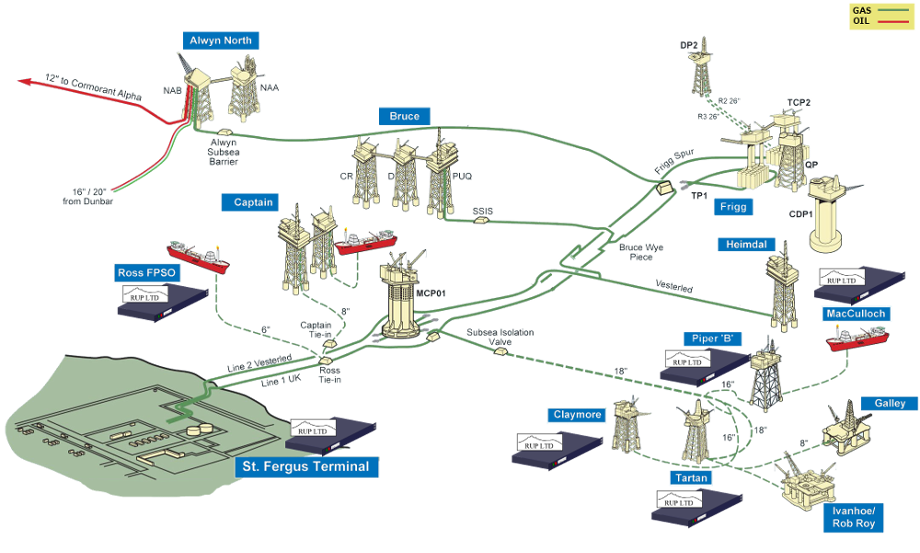
The MCP01 and MacCulloch are now decommissioned. Galley is now a well-tie-in.
TALISMAN BUCHAN – MONTROSE PIPELINE TELEMETRY SYSTEM, PTS
The Talisman Buchan – Montrose Pipeline Telemetry System, PTS, is comprised of various nodes: one onshore node at Talisman office and offshore nodes at Buchan and Montrose platforms respectively. The system exchanges pipeline related data between BP's Forties Pipeline Control System at Kinneil.
The Talisman nodes are powered by RUPDB software.
HOW TO ORDER
We supply the Pipeline Telemetry & Integrity System directly to our customers. Please contact us with your requirements.
ORDERING OPTIONS
The PTS and PLIS are available in a variety of configurations and options.
|
Remote Access Support Remote access support options: SSH, VPN (OpenVPN) and VNC over SSH tunnel. |
|
On-going Annual Support & Warranty Extension Covers technical queries, troubleshooting and software updates. Also includes hardware warranty extension for the life of the system. |
|
Onshore Data Server The onshore data server provides data archiving and display functions. This option helps in minimising data traffic over satellite links usually found in offshore applications. |
CONTACT
Address: Unit 16, Netherton Business Centre, Kemnay, Aberdeenshire, AB51 5LX, United Kingdom.
Website: www.rup.co.uk
Email: rup@rup.co.uk
Tel: +44 1467 642950

Software Development, Computer Systems, Consultancy Services
Copyright © 2016 RUP Limited. All rights reserved.